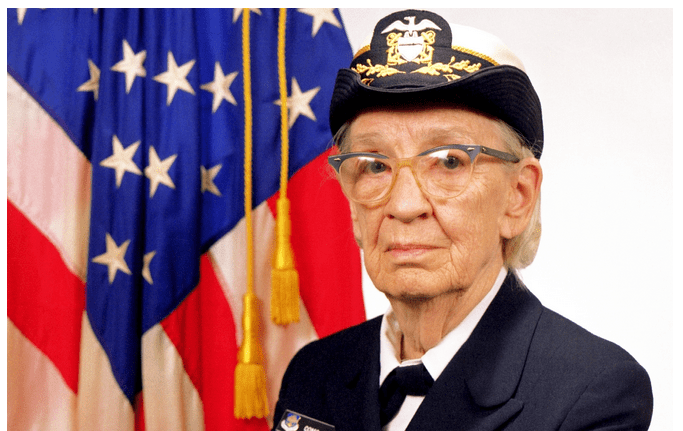
Grace Murray Hopper—ever heard of her? If you’re reading this on a computer, you’ve benefited from her groundbreaking work. A pioneer in computer science Hopper’s influence reaches far beyond the world of coding. Hopper was known as the first lady of software.
Grace Hopper’s curiosity and thirst for knowledge started at a young age. As a young child she dismantled several clocks to see how they worked.
She earned a bachelor’s degree in mathematics and physics from Vassar and a PhD in mathematics from Yale in 1934. She returned to Vassar as a professor, teaching math until World War II changed the course of her career.
When Hopper attempted to enlist in the U.S. Navy in 1943, she was initially rejected. She was 34 and considered too old. Her diminutive size was an issue, and her role as a mathematics professor was deemed more valuable to the war effort. Determined to enlist she secured a leave absence from Vassar and joined the Women Accepted for Volunteer Emergency Service (WAVES) program.

Hopper joined Howard Aiken’s team working on the Harvard Mark I computer, one of the earliest electromechanical computers. She was instrumental in writing the first-ever computer manual teaching others how to program. She also co-authored Understanding Computers, which was one of my college textbooks.
She was also part of the team that developed the UNIVAC I, the first commercial computer in the U.S. Hopper is credited with developing the first compiler, a crucial innovation that allowed humans to write instructions in a programming language rather than raw machine code. This breakthrough paved the way for COBOL (Common Business-Oriented Language), a programming language still in use today.
Legend has it that Hopper coined the term “debugging” after removing a moth stuck in a relay inside the Mark II computer. Though she often clarified that she didn’t invent the phrase, the anecdote remains a favorite in computing history.
Hopper was a strong advocate for making programming more accessible. She believed coding should resemble English rather than complex numerical machine code. Her work directly influenced the development of modern programming languages and laid the foundation for HTML and other user friendly languages.
Though she officially retired from the Naval Reserve at age 60, the Navy wasn’t ready to let her go. In 1967, she was recalled for what was supposed to be a six-month assignment. She retired again in 1971 but was recalled in 1972.
In 1983, President Reagan promoted Hopper to the rank of commodore (later renamed rear admiral), making her one of the few women to achieve flag officer status in the Navy. When she retired in 1986, she was the oldest active-duty commissioned officer in the U.S. Navy at the age of 79.
Grace Hopper’s contributions earned her countless accolades, including the Presidential Medal of Freedom, awarded posthumously in 2016 by President Barack Obama. The U.S. Navy even named a guided-missile destroyer, the USS Hopper, in her honor.
Her famous quote sums up her philosophy:
“The most dangerous phrase in the language is, ‘We’ve always done it this way.’”
She didn’t just change computing—she changed the way we think about progress.

 The Dee Zone
The article you posted Stuff They Don’t Want You To Know: Rear Admiral Grace Murry Hopper saddens me. My husband was a computer programmer in the USMC (which is attached to the Navy). He was part of a team writing a vital program on a UNIVAC computer. He used FORTRAN and COBOL computer languages which Rear Admiral Grace Murry Hopper (ret) had developed. After his USMC service was over, my husband was hired as a programmer for several other companies. He was a valuable asset because he knew FORTRAN and COBOL.
So, in a way, Admiral Hopper provided a living for us.
I don’t understand why “they” are eliminating links to information about historically important women from government websites, but links to the men still seem to be available. It is so hard to feel Christian kindness and forgiveness of persons with values and actions which seem harsh and hurtful. Those people seem to feel they are making the world better by not allowing specific “groups” to exist.
I hope people like George Washington Carver and Martin Luther King don’t get eliminated from history books. They are two men I admire. I hope “they” don’t cancel Martin Luther King Day, Memorial Day, Labor day as federal holidays.
Well, enough of my ramblings. I need to get back to my projects which will help my world be better. 🙂
LikeLike
Very cool, about your husband.
The simple reason for eliminating history is that it is a straight out of the dictator’s playbook. By controlling history and media they can control the masses.
The head guy obliviously has little understanding or knowledge of history among other things. He tech bro is not from this country and doesn’t seem to value anything but himself. As for the minion he just follows along like a little puppy.
It is obvious that they have little appreciation for history.
LikeLike